Baci di Dama
Hazelnut Kiss Cookies- Yield
- About 40 sandwich cookies
- Active
- 1 hour
- Total
- About 4 hours, including chilling
- Difficulty
- Medium
The story
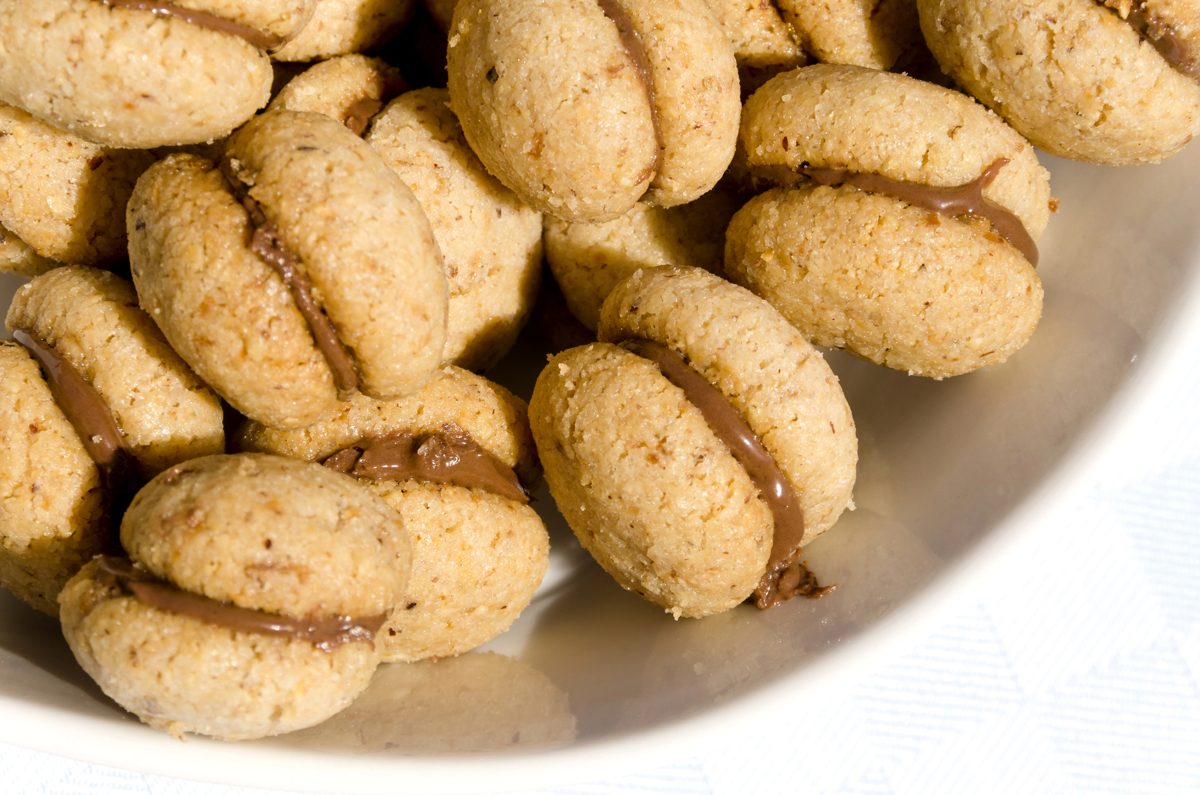
Baci di dama means lady's kisses, and the name describes the shape: two small domed cookies joined by a thin layer of dark chocolate, said to look like a pair of lips meeting in a kiss. The cookies come from Tortona in Piedmont, where local studies place their origin in the 19th century, and the region lists them as a traditional food product. Several stories compete for their invention. The best known says that in the autumn of 1852 a cook of the House of Savoy created them because King Victor Emmanuel II wanted to taste a new sweet. Another names Augusto Manelli, a pastry maker from Novi Ligure who moved his business to Tortona. The first cookies were made with Piedmont hazelnuts, which were cheaper and easier to find than almonds. Stefano Vercesi later switched to almonds and patented the cookies as baci dorati, golden kisses, which won a gold medal at the 1906 Milan International Exhibition, and Tortona still makes them with almonds. No wedding or courtship custom is attached to them; the romance is in the name. Italy marks February 14 with special warmth in Terni, in Umbria, where St. Valentine's remains rest in a basilica. Set out a small plate of them with espresso after dinner.
Ingredients
- For the cookies:
- 1 cup whole blanched hazelnuts (about 5 oz)
- 2/3 cup granulated sugar, divided
- 1 cup plus 2 tablespoons all-purpose flour
- 10 tablespoons (1/2 cup plus 2 tablespoons) cold unsalted butter, cubed
- 1/8 teaspoon salt
- 1/2 teaspoon vanilla extract
- For the filling:
- 4 oz dark chocolate, chopped
Sold in bulk bins, at Trader Joe's and online. Skin-on hazelnuts work if you rub off the skins after toasting; blanched almonds give the Tortona version.
Method
- Heat the oven to 350°F. Spread the hazelnuts on a baking sheet and toast until fragrant and lightly golden, 8 to 10 minutes. If any skins remain, rub them off in a kitchen towel. Turn off the oven and let the nuts cool completely.
- Grind the nuts with 2 tablespoons of the sugar in a food processor, pulsing, until they look like fine meal; stop before they turn oily.
- Add the flour, cold butter, remaining sugar, salt and vanilla and pulse until the mixture is sandy and then just starts to clump into a dough.
- Turn the dough out, press it into a flat block, wrap it, and refrigerate for at least 2 hours or overnight.
- Line two baking sheets with parchment. Break off pieces of about 1/4 oz and roll them into smooth balls about 3/4 inch across; place them 1 inch apart, flat side down. Refrigerate the trays for 30 minutes so the cookies keep their domed shape. Meanwhile, heat the oven to 325°F.
- Bake one sheet at a time until the cookies are set and pale golden at the bottom edge, 15 to 18 minutes. Let cool completely on the sheet, since they are fragile while warm.
- Melt the chocolate in a bowl over barely simmering water, stirring, then let it cool until thick enough to hold its shape, about 10 minutes.
- Pair the cookies by size. Put a small dab of chocolate (about 1/4 teaspoon) on the flat side of one, press a second on top, and set upright on the tray. Let the chocolate set at cool room temperature, about 30 minutes.
Note: Keep the balls small and the same size so the halves match and bake through. The filled cookies keep up to 1 week in an airtight tin in a cool place; for the almond version made in Tortona, use blanched almonds in place of the hazelnuts.