Licitarsko srce
Croatian Licitar Heart- Yield
- About 10 hearts (4-inch)
- Active
- About 2 hours
- Total
- About 2 hours, plus overnight resting and 6 to 8 days drying
- Difficulty
- Medium
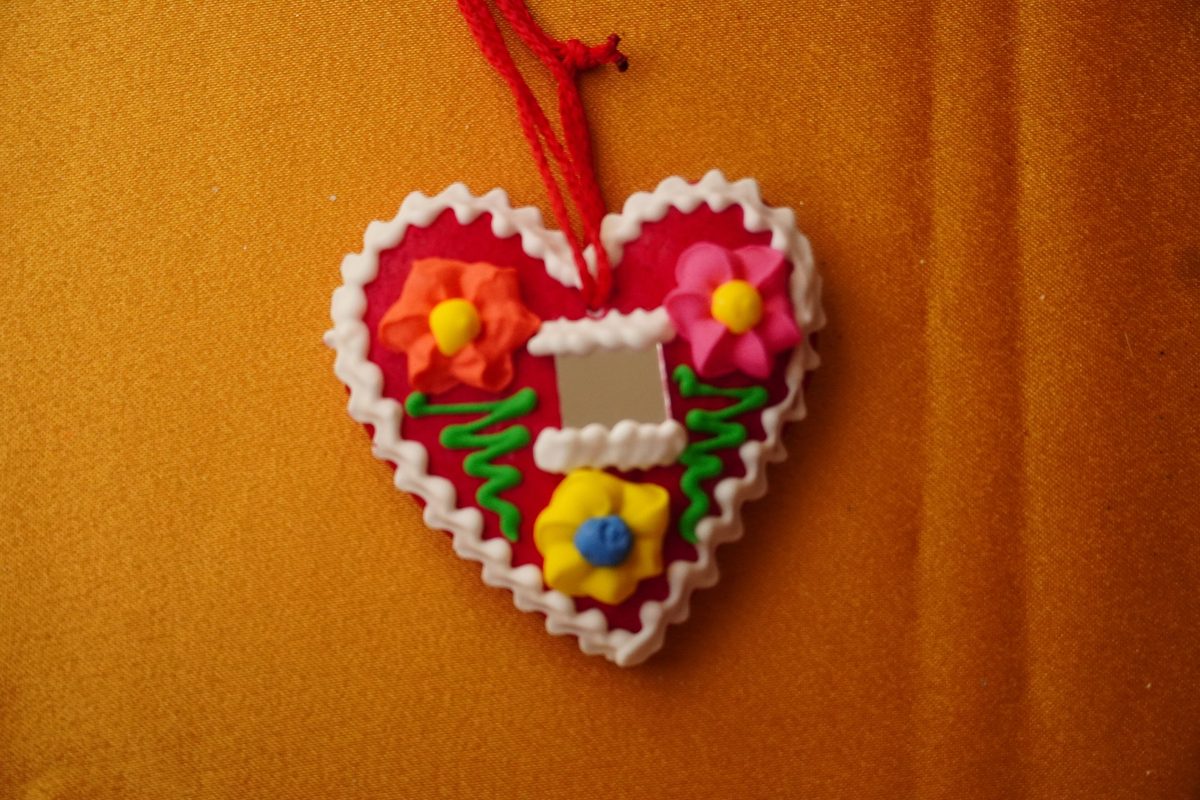
Photo: MikyM, CC BY-SA 4.0, via Wikimedia Commons
The story
In northern Croatia a red licitar heart was traditionally a token of love from a boy to a girl. Zagreb's city guide Love Zagreb tells how she gave her answer: if she kept the heart close, the feeling was mutual, and if she bit into it, he had been turned down. The hearts come from the medičari, family workshops that made honey, beeswax candles and gingerbread side by side, a trade recorded from the 16th and 17th centuries. In the 18th and 19th centuries the licitar makers of Zagreb, Karlovac, Varaždin, Koprivnica and Samobor were respected craftsmen who sold at parish fairs and pilgrimages. Marija Bistrica, a pilgrimage shrine town in Hrvatsko zagorje, is still the center of the craft, and its oldest workshop dates from 1882. The method has changed little: a sweet flour dough is shaped, baked, dried for days, glazed red and piped by hand, often around a small mirror. In 2010 UNESCO inscribed the Gingerbread craft from Northern Croatia on its Representative List of the Intangible Cultural Heritage of Humanity. Hearts reading volim te, I love you, are a newer design, and Croatia's tourism site now links the gift to Valentine's Day. Make one as a keepsake to set beside the plates, and buy or bake something else for dessert.
Ingredients
- For the dough:
- 1/2 cup water
- 1 cup sugar
- 3 1/4 cups all-purpose flour, plus more for rolling
- 1 1/4 teaspoons baking powder
- For the red glaze:
- 6 envelopes (1 1/2 oz) unflavored powdered gelatin
- 1/2 cup cold water
- 1 to 2 teaspoons red gel food coloring
- For the decoration:
- 1 1/2 cups powdered sugar
- 1 tablespoon meringue powder
- 2 to 3 tablespoons water
- Yellow and green gel food coloring (optional)
- About 10 small round craft mirrors, 3/4 to 1 inch across
- Thin red ribbon or thread, for hanging
Sold at US craft stores and online; leave them out and pipe a larger icing flower in the center if you cannot find them.
Method
- Bring the water and sugar to a boil in a saucepan, stirring until the sugar dissolves. Take the pan off the heat, add the flour all at once, and stir hard with a wooden spoon until no dry flour remains.
- When the dough is lukewarm, sprinkle in the baking powder and knead on a lightly floured surface until smooth and compact, 3 to 4 minutes. Wrap tightly and let rest at room temperature for at least 8 hours or overnight.
- Heat the oven to 475°F and line a baking sheet with parchment paper. Knead the dough briefly, roll it 1/4 inch thick, and cut out hearts with a 4-inch cutter.
- Bake one sheet at a time until the hearts are firm and pale yellow, 5 to 7 minutes; they should not brown. While they are still hot, pierce a hole near the top of each with a skewer for the ribbon.
- Cool the hearts on a rack, then leave them uncovered in a dry room for 5 to 7 days, until hard all the way through.
- For the glaze, sprinkle the gelatin over the cold water and let it soften for 5 minutes. Warm it gently, stirring, until fully dissolved, without letting it boil, then stir in red coloring until deep red. Let cool until slightly thickened.
- Spoon the glaze over the top and sides of each heart, set the hearts flat on a rack over parchment paper, and let them dry overnight. Rewarm the glaze gently if it sets in the pan.
- For the decoration, beat the powdered sugar, meringue powder and water into a thick, pipeable icing, and tint part of it yellow or green if you like. Press a dab of icing onto the back of each mirror and set it in the center of a heart.
- Pipe white borders, dots and scrolls around the mirror, add small colored flowers or a short message, and let the icing dry for several hours before threading the ribbon through the hole.
Note: A licitar is a keepsake, not a cookie to eat: it is baked hard, dried for days and set with a glass mirror, and Croatian makers sell it as a decoration. It uses a plain sugar-and-flour dough, unlike the spiced Christmas medenjaci (HR-05), which are made to be eaten.
Buying tip: Croatians buy licitar hearts from medičari, the family gingerbread workshops, at fairs, shrines and souvenir shops. In the US they turn up at Croatian community shops and online; look for hand-piped decoration and a maker's name, and keep them dry, since water ruins the glaze.