Soparnik
Dalmatian Swiss Chard Pie- Yield
- Serves 4 to 6 (one 13 x 18-inch pie)
- Active
- 45 minutes
- Total
- 1 hour 45 minutes
- Difficulty
- Medium
The story
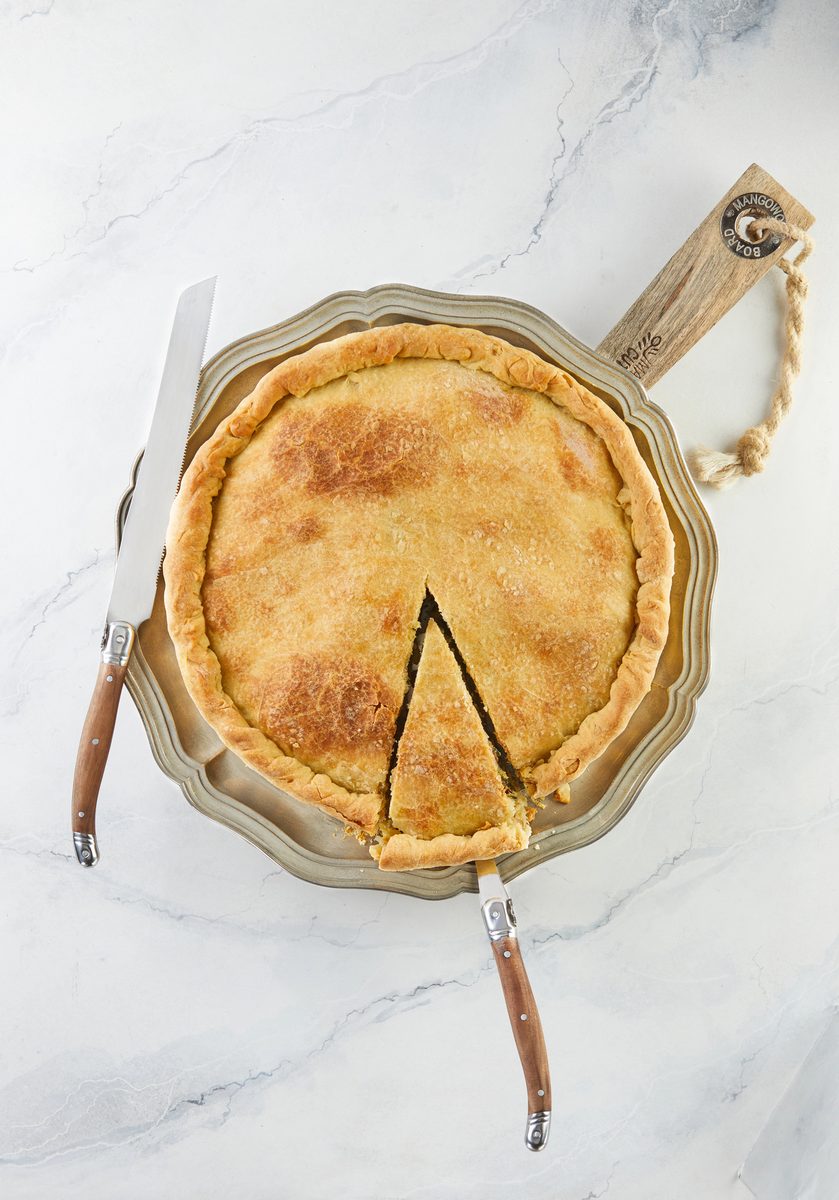
Soparnik comes from Poljica, the area around Omiš in central Dalmatia that formed the self-governing Poljica Republic from the late Middle Ages into the early modern period. Its ingredients are as plain as food gets: a dough of flour, water and salt, rolled thin, and a filling of raw Swiss chard with a little red onion and olive oil. It was baked on a komin, an open hearth, buried in embers and hot ash, then spread with olive oil and garlic and cut into diamonds. Village pies could be nearly a meter across, and older names for the dish include zelenik and uljenjak. Tradition called for old winter chard. Because it has no meat, eggs or dairy, soparnik belonged to fasting days. Poljica families recall baking it every Friday of Lent, and it is still made on Ash Wednesday, Good Friday and Christmas Eve; an old local account says there is no Christmas Eve in Poljica without salt cod and soparnik. Croatia lists it as intangible cultural heritage, and the EU registered Poljički soparnik as a protected geographical indication in 2016. In 2027 Lent begins on February 10. Serve it as a meatless main course with a green salad, or cut it into small diamonds for a buffet.
Ingredients and method
The full recipe, with US and metric measures and stand-ins for hard-to-find ingredients, is part of the Winter Folk Dishes edition. Buy it once and keep the PDF.
Want to try first? Krafne is free to cook.
Compared with
- Traditional Croatian Speciality 'Poljički Soparnik' Given EU Protection Status (Croatia Week)
- Thesis on Poljica traditions, Faculty of Humanities and Social Sciences Split repository (ffst:2352, PDF)
- Thesis on Croatian protected food products, Karlovac University of Applied Sciences repository (vguk:972, PDF)
- Kaj bo za kosilo? Dva kosa testa in vreča blitve (Siol.net)