Tsoureki
Greek Easter Bread- Yield
- 2 braided loaves, about 1 lb 2 oz each
- Active
- 1 hour
- Total
- 6 hours, including rising and cooling
- Difficulty
- Advanced
The story
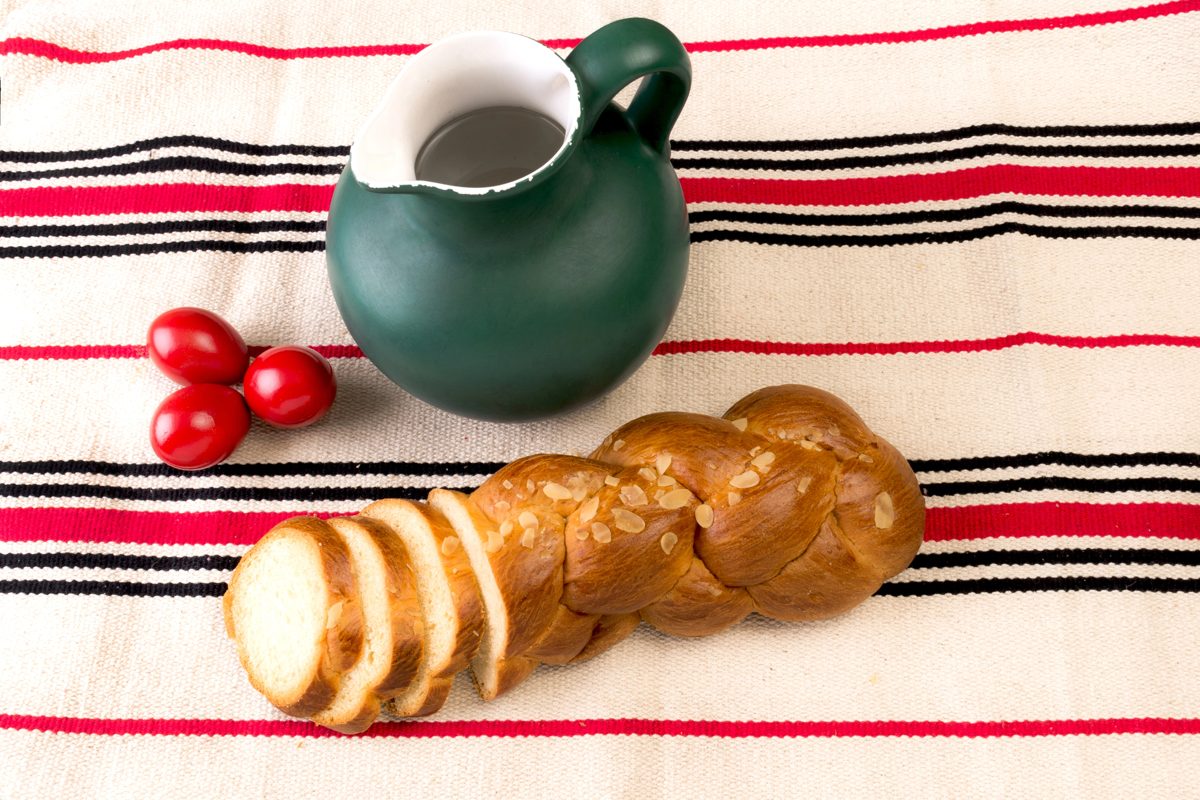
Tsoureki is the braided sweet bread of Greek Easter. Like the red eggs, it is traditionally made on Holy Thursday, which in 2027 falls on April 29 in the Orthodox calendar, and it is eaten after the midnight Resurrection service and on Easter Sunday, May 2. The dough is rich with eggs, sugar and butter, close to brioche. Its scent comes from two spices: mahlepi, the ground kernel of a cherry pit, and mastiha, the resin of an evergreen shrub grown on the island of Chios. Some family recipes add anise or cardamom. The name is often traced to the Turkish word for a yeast bread, corek. Most loaves are braided from three strands, which Greek writers link to the Holy Trinity, and many carry a red egg pressed into the braid. The work is slow, with long rises that can run through the day or overnight, which is why families set aside Holy Thursday for it along with the egg dyeing. The loaves keep for several days wrapped, so they can be baked on Thursday and still be soft for Easter breakfast.
Ingredients
- For the dough:
- 2/3 cup whole milk, warmed to 105–110°F
- 1 tablespoon instant or active dry yeast
- 2/3 cup sugar, divided
- 1/2 teaspoon mastiha (mastic) tears
- 4 cups bread flour, plus more as needed
- 1 teaspoon ground mahlepi
- 1/2 teaspoon fine salt
- Finely grated zest of 1 orange
- 2 large eggs plus 1 large yolk, at room temperature
- 1/2 cup (1 stick) unsalted butter, melted and cooled
- For the topping:
- 1 large egg yolk
- 1 tablespoon milk
- 1/4 cup sliced almonds or 2 tablespoons sesame seeds
- 2 red-dyed hard-cooked eggs (optional; see Kokkina avga)
Ground cherry-pit kernel sold at Greek and Middle Eastern grocers or online as mahlab. Substitute 1/4 teaspoon almond extract, added with the eggs.
Resin from Chios, sold at Greek grocers or online. If you cannot find it, leave it out and add 1/4 teaspoon ground cardamom.
Method
- Stir the yeast and 1 tablespoon of the sugar into the warm milk and let stand for 10 minutes, until foamy. Grind the mastiha tears with 1 teaspoon of the sugar to a fine powder in a mortar and pestle or spice grinder.
- In the bowl of a stand mixer, whisk together the flour, the rest of the sugar, the ground mastiha, mahlepi, salt and orange zest.
- Add the yeast mixture, eggs and yolk. Mix with the dough hook on low speed for 2 minutes, until a shaggy dough forms.
- With the mixer on medium-low, pour in the melted butter a little at a time, letting each addition disappear before adding more. Knead for 10 to 12 minutes, until the dough is smooth, elastic and slightly tacky and pulls away from the sides of the bowl; add flour 1 tablespoon at a time only if it stays wet.
- Shape the dough into a ball, place it in a lightly buttered bowl, cover, and let rise in a warm place (75–80°F) for 2 to 3 hours, until doubled.
- Turn the dough out and divide it into 6 equal pieces (about 6 oz each). Roll each into a 16-inch rope. Braid 3 ropes into a loaf, press the ends together and tuck them under; repeat with the other 3 ropes. Set the loaves on a parchment-lined baking sheet, at least 4 inches apart. If using red eggs, press one into the thickest part of each braid.
- Cover loosely and let rise for 1 to 1 1/2 hours, until puffy and nearly doubled. Heat the oven to 350°F during the last 30 minutes.
- Whisk the egg yolk with the milk and brush it over the loaves, avoiding the red eggs. Sprinkle with the almonds or sesame seeds.
- Bake for 30 to 35 minutes, until deep golden brown, hollow-sounding when tapped underneath and 190°F in the center. If the tops brown too fast, cover them loosely with foil after 15 minutes.
- Cool the loaves on a rack for at least 1 hour before slicing.
Note: Wrapped airtight, tsoureki keeps 3 to 4 days at room temperature and freezes for 2 months. Red eggs pressed into the braid are hard-cooked eggs: remove them after serving and refrigerate them, and eat them within a week.